IB Psychology
  • IB Psychology
    • IB Psychology Products
    • IB Psychology Blog
  • Biological
  • Cognitive
  • Social
  • Abnormal
  • Relationships
  • Model Essay Answers
  • Research Methods
  • The IA
    • Ultimate Guide to the IA
  • Syllabus Guide
  • Command Terms
  • Textbooks and Resources

Highlighting Critical Thinking in ERQs 

31/8/2015

 
Picture
Critical thinking is the hardest part to master in answering the IB Psychology extended response questions.
Getting the critical thinking component right in your IB Psychology exams is usually the final piece of the puzzle that needs to fall into place before full marks can be awarded.
Let us show you how it's done ...
The following IB Psychology essay is an exemplar of how critical thinking can be used in an essay for the Paper II IB Psychology examination. It answers the question: Discuss the role of communication in the maintenance of relationships, an ERQ related to the Human Relationships option in the IB Psychology course.

All of the text in dark blue font is an example of critical thinking in IB Psychology (you will need to see the embedded PDF, or download it). The flags and the corresponding comments are clarifications of why this is a good example of critical thinking.

Notice in the IB Psychology ERQ that three pieces of research (studies and/or theories) are used to make the argument - but then there are two paragraphs that take a holistic approach to the question. This is the "discussion" which is what the command term is asking the student to develop in the essay response.


Discuss the role of communication in the maintenance of relationships.

Communication plays a key role in all aspects of human relationships. It plays a role in our attraction to others, the way we solve problems and how much we trust one another. Marriage counsellors often focus on communication as a way to improve a relationship, but often problems in a relationship are complex. Communication may be a symptom, rather than a cause of the end of a relationship.

Research by Bradbury & Fincham found that couples engage in "relationship enhancing strategies" - that is, when a partner attributes good things to the disposition of their partner, and bad things to situational factors. This helps to maintain the relationship because it can enhance the sense of self-esteem of the partner. Couples in crisis tend to use distress-maintaining patterns - that is, they attribute good things to situational factors and bad things to disposition - meaning that the partner is unlikely to change. Although Bradbury & Fincham have documented this trend in relationships, it is difficult to determine if this is a cause or a symptom of the health of a relationship.


Gottman argues that it is not what we say, but how we say it. Our facial expressions communicate how we really feel about our partners. Gottman has couples come into his lab and then he codes their facial expressions under two conditions – discussing a non-threatening topic and discussing a controversial topic. Gottman argues that there are four “horses of the apocalypse” that help to predict if a relationship will end: criticism, defensiveness, contempt and stonewalling. Gottman argues that if a partner shows contempt during a discussion, this is a sign that the relationship is heading for divorce. One of the problems with this research, however, is that when Gottman tells couples that they are expressing these emotions, it may lead to a self-fulfilling prophecy. In addition, most of the couples that come to him for help are already in severe crisis. This may mean that the high predictive validity of his research has more to do with the fact that at least one of the partners may have already decided to end the relationship.


A final way that we use communication in relationships is disclosure – or the sharing of personal information with a partner. This is the basis of Social Penetration theory. This builds trust. Research has shown that we like people who disclose personal information. Although this seems logical, it is difficult to determine a cause and effect relationship between disclosure and the health of a relationship. It may be more likely that disclosure is the result of a healthy relationship than the cause of one.


There are many concerns about the study of the role of communication in relationships. First, how does a psychologists “observe” communication in a relationship? Often self-reported measures are used  – such as a questionnaire – to determine what the normal communication patterns are. This is difficult because the actual communications cannot be verified, so it is up to the perception of the person filling out the questionnaire. The information is open to distortion, especially if there is anger between the two partners. It can also be open to distortion if questions are asked about the history of the relationship. The peak-end rule argues that we tend to remember the most recent part of our relationship (the end) and specific events that stand out as rather exceptional (the peak). So, if the relationship is in bad shape, then the partners may only think about recent communication and this may distort their perception of the way that they have communicated throughout the relationship.


Another question is who is actually studied. A lot of the research done on communication is done on couples that are struggling with their relationship. Although some prospective research is now being done, traditionally it has been done with couples in counselling. Research should be done that looks at couples from the beginning of their relationship to truly measure how communication affects relationships long-term. It is also possible that although it is usually done with couples having problems, that the sample is also biased in other ways. A lot of the research is done on Western couples. In addition, the couples seek counselling, which may indicate a certain level of education or socioeconomic status. Finally, there is the problem of bidirectional ambiguity – that is, we cannot tell if the communication style leads to the quality of the relationship, or vice versa. It could be that there is a correlation, but no causation in either direction. Most importantly, the way we communicate is only one facet of a relationship. It is a reductionist approach to assess the health of a relationship only on communication styles.


The study of communication has led to successful strategies in marriage counselling that have helped people save their marriage by becoming more aware of how and what they say. However, labs like Gottman’s may communicate information to a couple – such as, she actually finds him disgusting – that may help to end the relationship. In this sense, the psychologist may validate one or both partners’ perceptions of the state of the relationship and decide to get divorced. Clearly more research is necessary.


IB Psychology ERQ Model answer: 
Discuss the role of communication in the maintenance of relationships.
Model Answer Download
Picture
Take the hard work out of preparing your IB Psychology model ERQs
Author: Derek Burton – Passionate about IB Psychology

IB Psychology Exam Questions

30/3/2015

 
Picture
Only the foolish leave the IB Psychology exams early
Your extended response answers will determine your final total mark
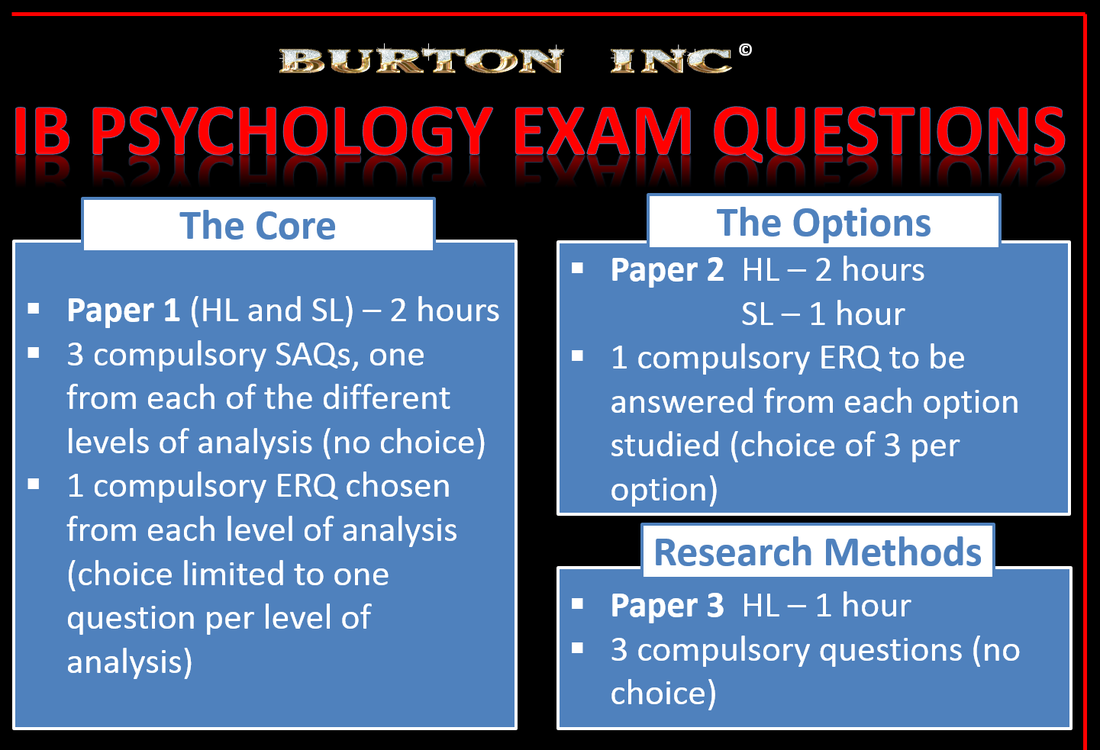
The IB Psychology exams consist of either Extended Response Questions (ERQs) or Short Answer Questions (SAQs). An ERQ is a 22 mark question and an SAQ is an 8 mark question in Papers 1 and 2. HL Paper 3 questions are worth just 10 marks each, but students are still required to show good knowledge and critical thinking to achieve the full 10 marks here (see an earlier post about Paper 3 answers here).

Your ability to write effective essay questions is tested to the limit in each of the three IB Psychology exams:
  • Paper 1 requires you to answer one ERQ and three SAQs, thus half your marks are weighted on your sole essay answer.
  • Paper 2 is only assessed through ERQs. 
  • Paper 3 are a messy hybrid, three SAQs that require you to show critical thinking as well as knowledge, thus, they are worth 10 marks each.
Picture
We have previously explained that there are no surprises in the IB Psychology examinations, you will know exactly the full range of ERQ questions that can be asked (see this previous post). An ERQ can never be based on a lower level learning outcome. For example the IB Psychology Sociocultural level of analysis has the learning outcome: "Explain 'emic' and 'etic' concepts." This will never be upgraded in the IB Psychology Paper 1 exam to a "Discuss 'emic' and 'etic' concepts" or "Evaluate research into 'emic' and 'etic' concepts".

However, the SAQs can be derived from a higher order learning outcome. For example, in the Cognitive Level of Analysis we have the learning outcome: "Evaluate two models or theories of one cognitive process." Now this can be asked as an ERQ or downgraded to an SAQ by changing the command term. To make this an 8 mark SAQ the command term 'evaluate' can be substituted for 'explain' or 'analyse', for example. Now the SAQ may become: "Explain one model of a cognitive process."

It is important that the student doesn't become too hung up on the three SAQs in the IB Psychology Paper 1 exam. The focus should always be on learning and practicing perfect model ERQs answers. If you they know the ERQ, the SAQ can easily be adapted.

To illustrate this in action, consider the IB Psychology SCLOA learning outcome: "Discuss factors influencing conformity." An obvious candidate for an ERQ in the exam. Once the model ERQ has been learned and practiced then, come exam time, the student will be ready if this is needed to be approached in different ways for a compulsory SAQ. There are a few ways the examiners could set this question. We provide model answers for the three most likely scenarios. The key to full marks here is to know one study well and to be able to explain the three major social influence processes, which the student will be able to do if he or she has learned the model ERQ answer.

Below we have three model SAQs based on the one higher order learning outcome follow; look for the different 'tweaks' based on the same information:
1. Explain one factor that influences conformity.
Conformity can be defined as adjusting one's behaviour or thinking to match those of other people or a group standard. There are three major social influence processes which have been proposed to explain conformity, and these are informational influence, normative influence and referent informational influence. All of these explanations are, and some to a large extent, based on the influence of social norms. Social norms are group-held beliefs about how members should behave in a given context. Sociologists describe norms as informal understandings that govern society’s behaviours, while psychologists have adopted a more general definition, recognising smaller group units, like a team or an office, may also endorse norms separate or in addition to cultural or societal expectations, thus, group norms can be seen as a smaller subset of social norms. The psychological definition emphasises social norms' behavioural component, stating norms have two dimensions: how much behaviour is exhibited and how much the group approves of that behaviour.

We are subjected to informational influence when we accept the views and attitudes of others as valid evidence about how things are in a particular situation. Having an accurate perception of reality is, of course, essential for our efficient functioning in our environment. Others are often viewed as valid sources of information, especially in situations where we cannot test the validity of our perceptions, beliefs and feelings.

Informational influence seems to be the most likely explanation for Sherif’s (1935) research findings. He investigated the formation of group norms and conformity in an ambiguous situation (Sherif, 1935). This study relies on the autokinetic effect – an optical illusion that makes a stationary light appear to move when seen in complete darkness. Participants were led to believe that the experiment was investigating visual perception and told that the experimenter was going to move the light, something that was never done. The participants had to make 100 judgements as to how far the light, placed on the far wall of a darkened room, seemed to have moved.

To start with, participants made their judgements alone. Their estimates fluctuated for some time before converging towards a standard estimate, a personal norm. Such personal norms varied considerably between participants. In further sessions of 100 trials on subsequent days, the participants were joined by two other participants. They took turns in a random order to call out their estimates of the light’s movements. In this group condition, participants’ estimates soon reflected the influence of estimates from the others in the group. Eventually a common group norm emerged, a social norm, which was the average of the individual estimates. Different groups formed different group norms. Interestingly, the participants denied that their estimates were influenced by the other group members. During a third phase of the study, participants performed the task alone again; their estimates showed a continued adherence to the social norm established during the group session.

Here, because reality was ambiguous, participants used other people’s estimates as information to remove the ambiguity. Informational influence tends to produce genuine change in people’s beliefs thus leading to private conformity. Sherif’s work is important because it demonstrates how, at least in ambiguous settings, social norms can develop and become internalised (that is, function without the need of the actual presence of others). However, informational influence cannot be the only explanation for conformity, because conformity can be observed in situations where there is no ambiguity.

2. With reference to a study, explain conformity.
Conformity can be defined as adjusting one's behaviour or thinking to match those of other people or a group standard. There are lots of reasons why people conform, including the desire/need to fit in or be accepted by others and maintaining order in one’s life.

There are three major social influence processes which have been proposed to explain conformity, and these are informational influence, normative influence and referent informational influence. All of these explanations are, and some to a large extent, based on the influence of social norms. Social norms are group-held beliefs about how members should behave in a given context.

We are subjected to informational influence when we accept the views and attitudes of others as valid evidence about how things are in a particular situation. Having an accurate perception of reality is, of course, essential for our efficient functioning in our environment. Others are often viewed as valid sources of information, especially in situations where we cannot test the validity of our perceptions, beliefs and feelings.

Normative influence is another explanation of conformity. Normative influence underlies our conformity to the expectations of others. This type of influence is based on the need to be liked and accepted by others (the need to belong is one of the fundamental human motivations). In fear of social disapproval and rejection, we often behave in ways that conform to what others expect of us with little concern about the accuracy of beliefs we express or the soundness of our actions.

SIT theorists have developed the referent informational influence hypothesis, and this forms the basis of SIT explanations of conformity. From an SIT perspective, conformity is not simply a matter of adhering to just any social norms; it is more likely to do with adhering to a person’s ingroup norms. We conform out of a sense of belongingness and by doing so we form and maintain desired social identities. It follows from this that we are far more likely to conform to the norms of groups we believe we belong to and identify with.

Informational influence seems to be the most likely explanation for Sherif’s (1935) research findings. He investigated the formation of group norms and conformity in an ambiguous situation (Sherif, 1935). This study relies on the autokinetic effect – an optical illusion that makes a stationary light appear to move when seen in complete darkness. Participants were led to believe that the experiment was investigating visual perception and told that the experimenter was going to move the light, something that was never done. The participants had to make 100 judgements as to how far the light, placed on the far wall of a darkened room, seemed to have moved.

To start with, participants made their judgements alone. Their estimates fluctuated for some time before converging towards a standard estimate, a personal norm. Such personal norms varied considerably between participants. In further sessions of 100 trials on subsequent days, the participants were joined by two other participants. They took turns in a random order to call out their estimates of the light’s movements. In this group condition, participants’ estimates soon reflected the influence of estimates from the others in the group. Eventually a common group norm emerged, a social norm, which was the average of the individual estimates. Different groups formed different group norms. Interestingly, the participants denied that their estimates were influenced by the other group members. During a third phase of the study, participants performed the task alone again; their estimates showed a continued adherence to the social norm established during the group session.

 3. Explain the strengths and limitations of one study on conformity
Informational influence seems to be the most likely explanation for Sherif’s (1935) research findings. He investigated the formation of group norms and conformity in an ambiguous situation (Sherif, 1935). This study relies on the autokinetic effect – an optical illusion that makes a stationary light appear to move when seen in complete darkness. Participants were led to believe that the experiment was investigating visual perception and told that the experimenter was going to move the light, something that was never done. The participants had to make 100 judgements as to how far the light, placed on the far wall of a darkened room, seemed to have moved.

To start with, participants made their judgements alone. Their estimates fluctuated for some time before converging towards a standard estimate, a personal norm. Such personal norms varied considerably between participants. In further sessions of 100 trials on subsequent days, the participants were joined by two other participants. They took turns in a random order to call out their estimates of the light’s movements. In this group condition, participants’ estimates soon reflected the influence of estimates from the others in the group. Eventually a common group norm emerged, a social norm, which was the average of the individual estimates. Different groups formed different group norms. Interestingly, the participants denied that their estimates were influenced by the other group members. During a third phase of the study, participants performed the task alone again; their estimates showed a continued adherence to the social norm established during the group session.

Here, because reality was ambiguous, participants used other people’s estimates as information to remove the ambiguity. Informational influence tends to produce genuine change in people’s beliefs thus leading to private conformity. Sherif’s work is important because it demonstrates how, at least in ambiguous settings, social norms can develop and become internalised (that is, function without the need of the actual presence of others). However, informational influence cannot be the only explanation for conformity, because conformity can be observed in situations where there is no ambiguity.

The strengths of Sherif’s study include the fact that it was pioneering and still remains one of the most influential experiments in social psychology today. It has generated a large amount of research, especially in the role of group norms on conformity behaviour. The study clearly demonstrates how a group norm can be established and then continues to influence a person’s judgement even when the social influence of the group is no longer present.

A minor limitation to this experiment surrounds the ethics of the deception involved. Participants were not informed about the purpose of the experiment (informed consent) but this was not the norm at the time of Sherif’s experiments, and the deception was arguably slight and necessary to avoid demand characteristics. Participants were debriefed at the end as to the true intents and purposes of the experiment. The major limitation is its lack of ecological validity. The task was artificial and ambiguous, and it is arguable that such ambiguous situations would never occur in real life situations. A possible counter argument to this criticism is that cognitive ‘anchoring’ can occur in our social groups.  We have a tendency to use anchors or reference points to make decisions and evaluations, and sometimes these lead us astray.  For example, if someone in my ingroup of girls informed me that 99% of teenage boys have body odour problems, then my perception of outgroup members on this domain will be influenced upwards towards this high initial anchor. Further, it turns out that we do not need the situation to be ambiguous for conformity to group norms to be observed.


Picture
Picture
Of course, IB Psychology has taken all of the hard work out of your model answer preparation. We have the complete IB Psychology ERQ model answers, across both Paper 1 and Paper 2 exams, as well as the complete collection of model answers to the SAQ questions likely to be asked in the Paper 1 exam. 

We know you don't need reminding, but you should be well into your revision programme now. C'mon that IB Psychology 7!
Author: Derek Burton – Passionate about IB Psychology
Quality Not Quantity

28/12/2014

Comments

 
It's not how much you write in the IB Psychology exams, it's what you write
Picture
Students are always asking me how much they should be writing to answer a particular IB Psychology exam question. My response is always the same. Enough to meet the requirements of the particular IB Psychology command term (which I've covered in a previous post) and enough to provide sufficient information to answer the question ... but no more than that! Any unnecessary, extra time a student spends on one of their IB Psychology exam questions is time that she doesn't have to spend answering another examination question. And I have never met a student yet, in my long, long, long IB Psychology teaching career who has come out of an exam with that magical and elusive 7 saying that she had plenty of time to spare (therefore the exam paper doodling). 

To prove this point, take a look at two sample responses to short answer questions (SAQs) asked in past IB Psychology examinations (Paper 1, SL and HL). One response is an SAQ associated with the Cognitive Level of Analysis, the other, the Socio-Cultural Level of Analysis. You will see that full marks in SAQs can usually be gained with less than a page of writing, easily. 

The Cognitive Level of Analysis question: WITH REFERENCE TO ONE RESEARCH STUDY, EXPLAIN HOW ONE BIOLOGICAL FACTOR MAY AFFECT ONE COGNITIVE PROCESS

Biological factors, such as hormones, can affect the cognitive process of memory. Hormones are chemical messengers secreted by cell or gland. These messengers are sent out from one part of the body to affect cells in other parts of the body. Hormones are often released directly into the bloodstream.


One study done on this was by Newcomer. Newcomer wanted to test the role of glucocorticoids on memory. Glucocorticoids are chemicals that can stop inflammation. As Meany had found, exposure to high levels of glucocorticoids lead to a decrease in memory in rats and atrophy of the hippocampus. Newcomer wanted to see if this was also true in human beings. He wanted to test the effect of cortisol, a stress hormone secreted by the adrenal glands, on verbal declarative memory. The hippocampus plays the role of transferring declarative memories from STM to LTM. Cortisol appears to lead to hippocampal cell death.


Newcomer ran a double-blind test in which participants either were given a high dose of cortisol (similar to a high level of stress), a low dose of cortisol or a placebo over a period of four days. The participants were asked to read a piece of prose. After the four days, they were asked to recall the data from the prose. Newcomer found that those who had been given high levels of cortisol had the worst recall of the text. When they stopped taking the pills, their memory levels returned to normal. Newcomer concluded that cortisol has a negative effect on the transfer and retrieval of STM to LTM.


The Socio-Cultural Level of Analysis question: DESCRIBE ONE THEORY OF HOW STEREOTYPES ARE FORMED

One theory that explains how stereotypes are formed is through either experience or society and then confirmation bias. Stereotypes are schema that people have of other people. These usually form from experiencing a certain event multiple times or from what society tells you to think. One study on the formation of stereotypes was done by Rogers & Frantz. They aimed to see if the amount of time that somebody was in Rhodesia (today Zimbabwe) would affect their stereotypes of the locals. They studied European settlers in Rhodesia. They gave participants a test where multiple segregation and discrimination laws were listed, showing how much better the whites were treated in Rhodesia than the blacks. They then asked them how much they wanted things to either stay the same or change. The results were that the longer somebody had lived in Rhodesia, the less they wanted things to change and the more they liked the status quo. This shows that the longer someone had been living there, the higher amount of the stereotypes he had towards the locals.

Those that wanted the change the most were the ones that had been there the least amount of time. This indicates that stereotypes form over time. When new European settlers came to Rhodesia they had no idea what to think and had no stereotypes toward the Africans. Because of this, they looked to others to see what to think. This is called informational social influence. They conformed to the ideas and stereotypes already existing in the White European community. They did this in order to connect to their “in-group.” Once learning these stereotypes, they then experience confirmation bias. This is when they only see and remember things that fit into the stereotype or schema that they now had of the locals and ignored the things that went against these stereotypes. This is how their stereotypes got stronger. One theory of the formation of stereotypes is that people look to others they consider their in-group to see what to think. Then through confirmation bias these stereotypes increase in intensity. The more time the Europeans had been in Rhodesia, the more they felt ok with discrimination against the locals and the stronger their stereotypes were.


Download the Model Answers here to share with your students or use for your IB Psychology examination revision.
Picture
Author: Derek Burton – Passionate about IB Psychology


Comments

The First Commandment of IB Psychology

21/2/2014

Comments

 
Know thy command terms.
In search of perfect answers to your IB Psychology examination questions? You will need to start with the command term. "Outline two principles that define the cognitive level of analysis" will be answered differently from "Explain the two principles that define the cognitive level of analysis." Outline and Explain are both examples of command terms that can be used in short answer exam questions. That difference needs to be apparent in your answer to each question - you can be sure that the beady little eyes of the IB examiner will be scrutinising your answer for this information.

When answering IB Psychology exam questions it is important to identify the command term in each question. These will determine how you should answer the question. Command terms such as 'explain', 'outline', ‘examine’, 'to what extent', and so on carry different meanings and this should be reflected in your answers.

The command term in an examination question is very important. It provides two things the examiner is looking for and specifically awarding (or penalising!) you marks for. The first is structure. Are you structuring you answer according to the command term to answer the question? Secondly, has your answer ‘effectively addressed the command term’? 

Below is one of the markband descriptors IB Psychology examiners are using to mark you Short Answer Questions (i.e. those three 8 mark questions in the Paper 1 exam). Not addressing the command term will limit your maximum mark to 6 marks, instead of the full 8 had your answer effectively addressed the command term.
Picture
The first commandment of IB Psychology
Your flashcard set is proving to be a great way to get my students practicing their command terms.
- Jane Freeeman, 1st year IB Psychology teacher

Picture
Every IB Psychology examination question has a command term

Picture
In the long answer Extended Response Questions (ERQs), those 22 mark essay questions in the Paper 1 and 2 HL and SL IB Psychology exams, examiners are looking for and marking command term application in two of the criteria they are assessing. 
Picture
Picture
If the command term is incorrectly addressed in your answer, you will be limited to a maximum of 6 marks for Criterion B (maximum possible 9 marks) and to a maximum of 2 marks in Criterion C (with a maximum possible 4 marks that can be awarded. That is an enormous 5 marks you are giving up for each Extended Response Question in the exams. And you will need to answer three ERQs if you are a HL IB Psychology student, and two if studying at SL. Another 2 marks across three SAQs will be forfeited in the HL and SL Paper 1 exam.

Conclusion: If you do not learn your command terms and practice tailored answers to the IB examination questions according to the command term requirement you will be foregoing many marks and at least an entire grade boundary in your total IB Psychology score, possible two. Knowing your command terms could easily elevate your IB Psychology Diploma mark from a 5 to a 7 to ensure maximum success, or from a 3 to a 4 to avoid certain failure. Thus, the first rule of IB Psychology is: KNOW THY COMMAND TERMS.

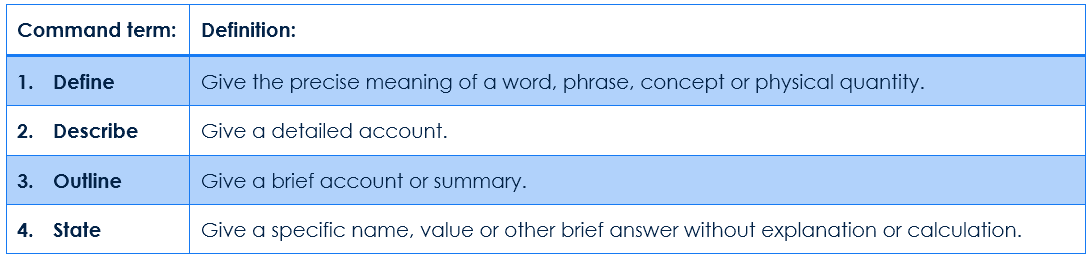
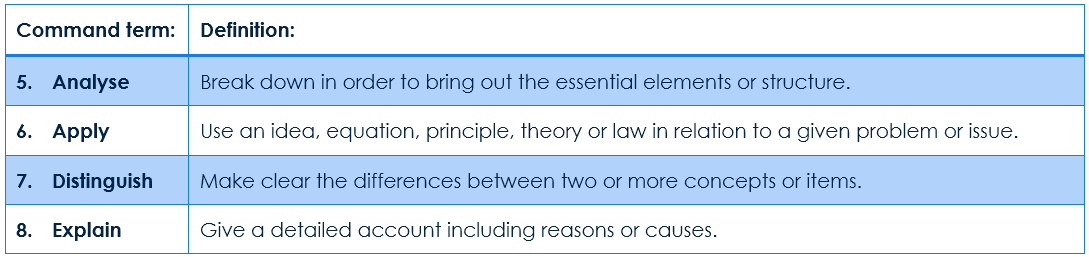
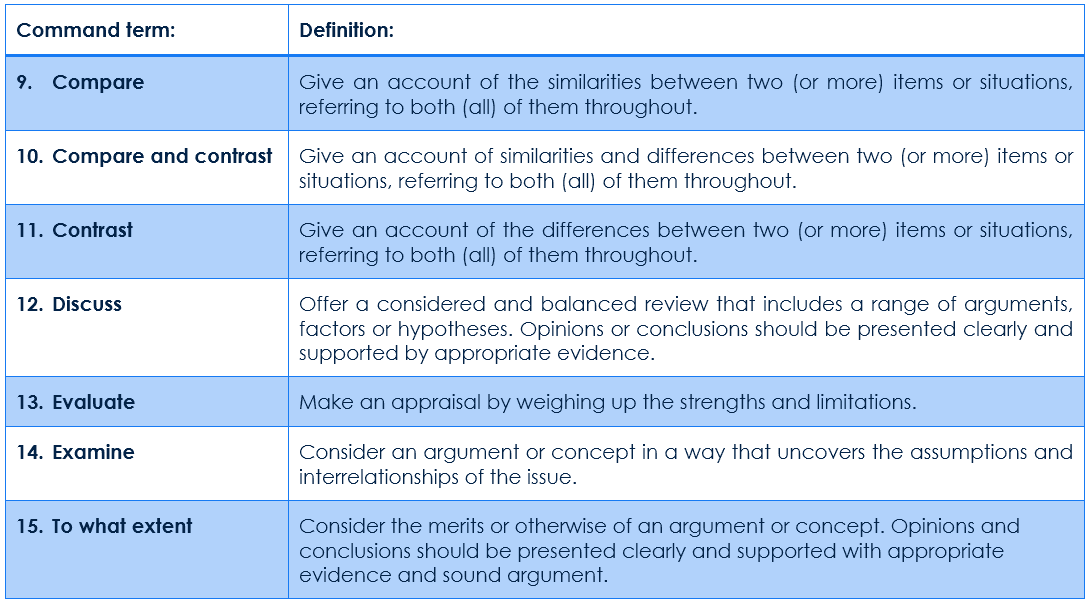
The tables below summarises how you should use the command terms when you are answering questions and how they apply to particular questions. I will actively look for a particular structure associated with the command term to be present in a student's answer when assessing their SAQ or ERQ answer. If their knowledge and comprehension is outstanding and the critical thinking deep and analytical, I still will not award full marks if I believe the command term has not been addressed. Harsh!

There are 15 IB Psychology command terms in total. Only seven of these can be used to ask the extended response exam questions.

Command terms associated with assessment objective 1: Knowledge and comprehension

Picture

Command terms associated with assessment objective 2: Application and analysis

Picture

Command terms associated with assessment objective 3: Synthesis and evaluation

Picture
Important information about IB Psychology command terms:

In the learning outcomes (see syllabus content) the command terms are associated with assessment objectives 1, 2 or 3 and indicate the depth of understanding that is required of students in relation to each item of content. The grouping of command terms under assessment objectives reflects the cognitive demand of each term and is related to Bloom’s taxonomy.
  • A command term used in an examination question will be:
  • The same as that specified in the related learning outcome, or
  • Another command term associated with the same assessment objective, or
  • A command term of less cognitive demand.
For example, if a learning outcome begins with the command term “explain”, an examination question based on this learning outcome could contain the command term “explain”, another command term associated with assessment objective 2 (such as “analyse”), or a command term associated with assessment objective 1 (such as “describe”), but not a command term associated with assessment objective 3 (such as “evaluate”).

This means: A lower level learning outcome (e.g. ‘Explain one study related to localization of function in the brain’ will never be asked as a 22 mark ERQ in the IB Psychology examinations. It means you can plan your ERQ answers in advance and think about how you can adapt each answer if it is asked with a different command term. Don't delay. Start practicing today.

Notes on Command Terms: PDF Download
Author: Derek Burton – Passionate about IB Psychology

Comments

    IB DipLOMA PsychologY:

    The IB Psychology Blog. A place to share research and teaching and learning ideas for those studying and teaching Psychology for the IB Diploma Programme.

    Archives

    April 2016
    March 2016
    February 2016
    January 2016
    November 2015
    October 2015
    August 2015
    July 2015
    June 2015
    May 2015
    April 2015
    March 2015
    January 2015
    December 2014
    November 2014
    October 2014
    September 2014
    August 2014
    July 2014
    June 2014
    May 2014
    April 2014
    March 2014
    February 2014


    Categories

    All
    Abnormality
    Abnormal Psychology
    Antidepressants
    Anxiety Disorders
    Attraction
    Attributions
    Biological Level Of Analysis
    Biological Psychology
    BLOA
    Bystander Effect
    Bystanderism
    Classroom Experiments
    CLOA
    Cognition
    Cognitive Level Of Analysis
    Cognitive Psychology
    Command Terms
    Communication
    Decision Making
    Decision-making
    Depression
    Diagnosis
    Discrimination
    ERQ
    Errors In Attribution
    Essay Questions
    Ethics
    Evolutionary Psychology
    Examinations
    Exams
    Experiment
    Extended Response Question
    Getting A 7
    Getting An IB Psychology 7
    HL
    Human Relationships
    IA
    IB Psychology
    IB Psychology 7
    Learning Outcomes
    Long Answer Questions
    Mental Illness
    Model Answers
    Paper 1 Examinantion
    Paper 2 Examination
    Paper 3 Examination
    Paper 3 HL Exam
    Placebo
    QRM
    Qualitative Research Methods
    Realtionships
    Relationships
    Revision
    SAQ
    SCLOA
    Short Answer Questions
    SL
    Socio Cultural Psychology
    Socio-Cultural Psychology
    Stereotypes
    Study
    Syllabus
    Teaching
    Teaching Ideas
    Teaching Tips
    Treatment
    Treatment Of Depression

    RSS Feed

© Burton Inc. and VIBE Education Ltd.  2012-2021. All rights reserved.